
Konica Minolta AF DT 18-70/3.5-5.6 vs. Minolta AF 17-35/3.5 G
David vs. Goliath
October 9th, 2006 - 04:44:13 PM:
Recently I bought the Konica Minolta AF DT 18-70/3.5-5.6 (D), the lens that is commonly sold as a kit with the Dynax/Maxxum 7D, 5D and, with a Sony name tag, with the Sony Alpha 100. At the same time, I already own the Minolta AF 17-35/3.5 G, so it was interesting to compare the two.
Of course, you may immediately ask “Is this a fair comparison, when the G lens costs 15 times more? Will you get any meaningful results?”. Sure, the cheap kit lens has no chance to outperform the G lens. The 17-35/3.5 G is without a doubt one of the best wide angle zoom lenses, so it more or less sets the limits for what a zoom lens can achieve. So the question here is not “which one is better”, but “how big is the difference between the two”. Cheap kit lenses don't have the best reputation, to say the least, and it's interesting to see how well it does perform, even if it has no chance of winning. This comparison also gives an impression of what you can get if you spend a lot of money, or if it's O.K. to be cheap and still get acceptable results. Such a comparison, even if it seems unfair, makes much more sense to me than comparing two kit lenses from, for example, Konica Minolta and Canon. While such a comparison would be considered fair, the results would help neither the KM owner nor the Canon owner.
Also, you might ask “if you already own the G lens, why did you even buy the kit lens?”. Well, I simply wanted a small, lightweight, and slightly longer lens that I can take on a hiking tour or use at other opportunities to take non-critical photos, one that can even be damaged without causing a big loss of money (not that I intend to do so). More expensive alternatives would have been the Tamron SP AF17-50mm F/2.8 XR Di-II LD ASPHERICAL [IF] (what a name!) and the Carl Zeiss Vario-Sonnar T* DT 16-80/3.5-4.5 ZA. Unfortunately, as of the time of this writing, the Tamron lens is still not yet available with a Minolta mount, and release of the Carl Zeiss lens was postponed to 2007.
The competitors
The following table highlights the main differences between the two lenses.
| DT 18-70/3.5-5.6 | 17-35/3.5 G |
|---|---|
| APS-C only | Full frame |
| D lens | non-D lens |
| smaller, lighter (268 g) | larger, heavier (670 g) |
| Plastic construction, including bayonet | Metal construction |
| Longer zoom range | Limited zoom range |
| Slower at long end | Constant f/3.5 |
| Rotating filter threads | Non-rotating filter threads |
| No extras, not even a distance scale | Focus hold button, distance scale |
Also, the lens hood of the kit lens is only a shallow round bayonet mounted hood with limited effectiveness. This is a consequence of the rotating front. To be able to use a more effective flower-shaped hood you need a non-rotating front.
Full specifications can be found here for the G lens, and here for the kit lens.
If you handle both lenses, you immediately feel where some of the price difference originates. The G lens is a full metal construction, with only a few plastic and rubber parts on the outside shell. Even the lens hood is metal, attached to a plastic bayonet mount. The zoom and focus rings run smoothly.
The kit lens, on the other hand, is very lightweight and small for its zoom range. This is because it doesn't have to produce a full frame image circle, but only one to cover the APS-C size frame of current DSLRs. The lens is also slower. Already from 19 mm, the lens is f/4, from 24 mm it's f/4.5, from 30 mm it's f/5, and from 34 mm it's f/5.6. Finally, the lens barrel is 100% plastic, including the bayonet mount. While this sounds like a likely point of failure, I've not yet heard of someone breaking the plastic mount. The zoom ring does not run as smoothly and is a bit scratchy. The focus ring also doesn't run as smoothly, and noise from the AF gearing is a lot more prominent.
Image quality
I've tested both lenses with a 7D. I've tested the lenses for the following characteristics:
- Sharpness, wide open and stopped down
- Distortions
- Chromatic aberrations, wide open and stopped down
- Vignetting, wide open and stopped down
I've also tested flare (at the widest angle) to see how effective the lens hood actually is.
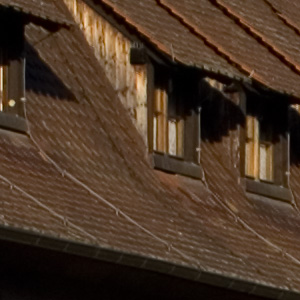
Following these studio test shots, I've also made a few real-life shots to see how the potential drawbacks of the kit lens play out in realistic photographic situations.
 |
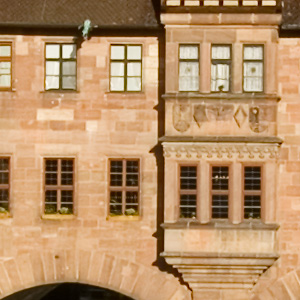
| The “Heilig-Geist-Spital” (“Hospice of the Holy Spirit”) in Nuremberg. |
Sharpness
The following test shots are 100% crops of the unsharpened image, converted from the RAW file. They were taken with the camera mounted on a tripod, using MLU.
| 18 mm, center | |
|---|---|
| 17-35/3.5 G | 18-70/3.5-5.6 |
 |  |
| f/3.5 | f/3.5 |
 |  |
| f/8 | f/8 |
| 18 mm, corner | |
|---|---|
| 17-35/3.5 G | 18-70/3.5-5.6 |
 |  |
| f/3.5 | f/3.5 |
 |  |
| f/8 | f/8 |
| 24 mm, center | |
|---|---|
| 17-35/3.5 G | 18-70/3.5-5.6 |
 |  |
| f/3.5 | f/4.5 |
 |  |
| f/8 | f/8 |
| 24 mm, corner | |
|---|---|
| 17-35/3.5 G | 18-70/3.5-5.6 |
 |  |
| f/3.5 | f/4.5 |
 |  |
| f/8 | f/8 |
| 35 mm, center | |
|---|---|
| 17-35/3.5 G | 18-70/3.5-5.6 |
 |  |
| f/3.5 | f/5.6 |
 |  |
| f/8 | f/8 |
| 35 mm, corner | |
|---|---|
| 17-35/3.5 G | 18-70/3.5-5.6 |
 |  |
| f/3.5 | f/5.6 |
 |  |
| f/8 | f/8 |
| 50 mm, center |
|---|
| 18-70/3.5-5.6 |
 |
| f/5.6 |
 |
| f/8 |
| 50 mm, corner |
|---|
| 18-70/3.5-5.6 |
 |
| f/5.6 |
 |
| f/8 |
| 70 mm, center |
|---|
| 18-70/3.5-5.6 |
 |
| f/5.6 |
 |
| f/8 |
| 70 mm, corner |
|---|
| 18-70/3.5-5.6 |
 |
| f/5.6 |
 |
| f/8 |
Center sharpness is very similar for both lenses. In the test shots you can hardly see any difference. This is probably because both lenses outperform the sensor of the camera. Future cameras with higher resolution will have to show a difference there. At 70 mm, weaknesses of the kit lens start to show up, and stopping down hardly increases sharpness.
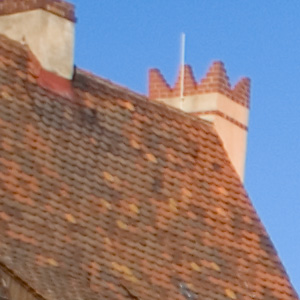
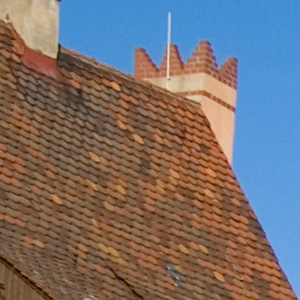
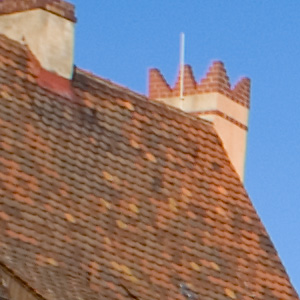
Corner performance is better for the G lens, as expected, especially wide open. When stopped down, both lenses gain a lot in sharpness. For the kit lens the gain is larger, so it can almost close the gap to the G lens.
Chromatic aberrations
| 18 mm, edge | |
|---|---|
| 17-35/3.5 G | 18-70/3.5-5.6 |
 |  |
| f/3.5 | f/3.5 |
 |  |
| f/8 | f/8 |
Chromatic aberrations are a different story. Here the G lens performs significantly better. With the kit lens, chromatic aberrations are very visible, especially at the edges of the frame, even when stopped down.
Distortions and vignetting
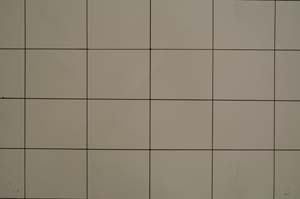
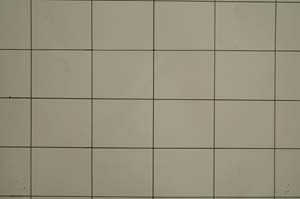
The following test shots are intentionally underexposed so that vignetting can be seen better. At correct exposure, vignetting is almost invisible.
| 18 mm | |
|---|---|
| 17-35/3.5 G | 18-70/3.5-5.6 |
 |  |
| f/3.5 | f/3.5 |
 |  |
| f/8 | f/8 |
| 20 mm | |
|---|---|
| 17-35/3.5 G | 18-70/3.5-5.6 |
 |  |
| f/3.5 | f/4 |
 |  |
| f/8 | f/8 |
| 24 mm | |
|---|---|
| 17-35/3.5 G | 18-70/3.5-5.6 |
 |  |
| f/3.5 | f/4.5 |
 |  |
| f/8 | f/8 |
| 35 mm | |
|---|---|
| 17-35/3.5 G | 18-70/3.5-5.6 |
 |  |
| f/3.5 | f/5.6 |
 |  |
| f/8 | f/8 |
| 50 mm |
|---|
| 18-70/3.5-5.6 |
 |
| f/5.6 |
 |
| f/8 |
| 70 mm |
|---|
| 18-70/3.5-5.6 |
 |
| f/5.6 |
 |
| f/8 |
As already seen in a previous test, vignetting of the G lens at 18 mm and wide open is quite visible, even when using only a reduced frame camera like the 7D. The kit lens fares a lot better in this respect. This may be due to the fact that the kit lens only has to illuminate the APS-C sized frame of the 7D, the smaller aperture and possible optimizations to the special needs of digital sensors.
As always, vignetting can be almost eliminated by stopping down, and is generally lower at longer focal lengths.
With regard to distortions, the G lens is significantly better at the wide end, up to 24 mm focal length. At longer focal lengths, both lenses show almost no distortions, and even at the long end, the kit lens stays distortion free.
Flare
The following test shots were made against a dark background and a light source just outside the frame. Each lens was tested with four shots, without a hood and with the supplied hood mounted, and wide open and stopped down.
| 18 mm, without hood | |
|---|---|
| 17-35/3.5 G | 18-70/3.5-5.6 |
 |  |
| f/3.5 | f/3.5 |
 |  |
| f/8 | f/8 |
| 18 mm, with hood | |
|---|---|
| 17-35/3.5 G | 18-70/3.5-5.6 |
 |  |
| f/3.5 | f/3.5 |
 |  |
| f/8 | f/8 |
The G lens is quite sensitive to flare. This can be explained with the large front element which is also at the front of the lens when zoomed to 18 mm. But when using the supplied lens hood, flare is reduced dramatically.
The kit lens also shows some flare when used without the hood, and it's also reduced when mounting the hood, even though it's only a shallow round design.
Morale: Use the hood, always.
Conclusion
Pros and Cons
17-35/3.5 G
- Better edge performance
- Lower chromatic aberrations
- Lower distortions
- Stronger vignetting
18-70/3.5-5.6
- Edge performance not as good
- Higher chromatic aberrations
- Stronger distortions
- Less vignetting
What this test shows is that the kit lens is not as bad as Internet folklore suggests. Especially with regard to vignetting, it performs a lot better than the much more expensive G lens. Vignetting often is a problem with older lens designs on digital cameras, and newer designs, even if inexpensive, can offer a significant improvement in this area.
Center sharpness is astonishingly good with the kit lens, and when stopped down, even corner sharpness approaches that of the G lens. The only weak point of the kit lens seems to be the longest focal lengths.
Overall weaknesses of the kit lens are distortions and chromatic aberrations.
Unlike in the biblical story, David does not win here. David was never expected to win.
In the end, the old saying “you get what you pay for” still holds true. It's also
true that you can't get everything at once, i. e. there is no lens with a long zoom range,
wide aperture, full frame coverage, solid construction, excellent image quality
and low price. You have to make compromises at some point. Thinking about it,
you can get everything, except the low price: buy both lenses, like I did.
Categories: Reviews, Lenses (Minolta) • Archive of all entries